As I’m sure you’re aware NDCG is a statistic used to measure the relevance of a search algorithm. It compares the returned results to a set of labels, aka a judgment list. These judgments might be explicit – a human being went through and labeled them – or they might be implicit – gathered from clickstream data. Or they might be LLM generated.
In any case, when compared against the returned search results, we can put a number on the relevance.
I’ve argued, of course, this whole NDCG way of evaluating search is overrated in real-life circumstances. Yet it’s still useful 😎.
And, by God, I’m exhausted from writing this same, boilerplate, code over-and-over-and-over again at very job I go to.
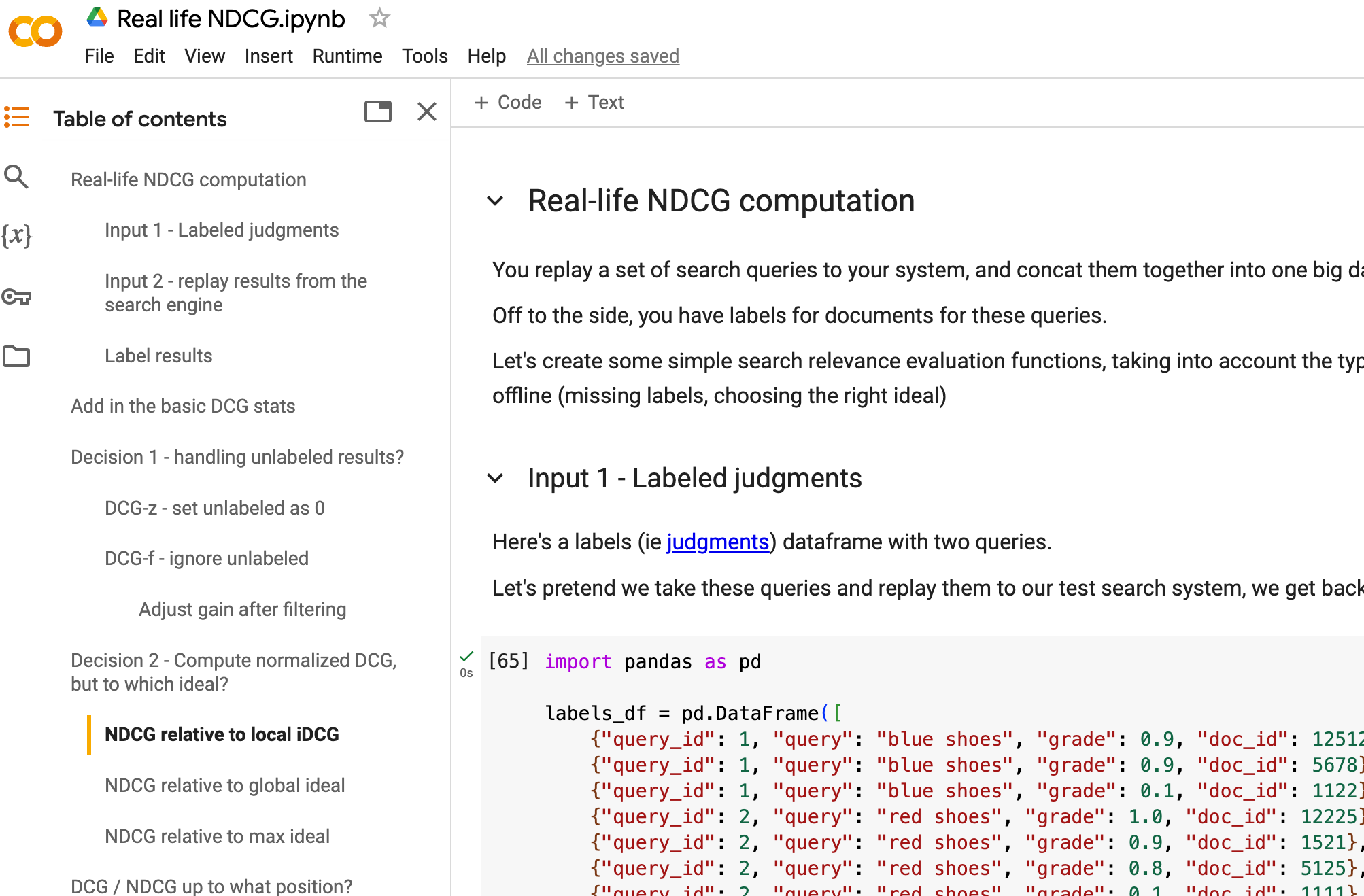
So here’s a useful notebook to walk you through the major decisions of NDCG calculation that matter to real-life search evaluation.
Enjoy!
 </img>
Starting in November: AI-Powered Search — Modern Retrieval for Humans & Agents

Learn the latest AI search skills with the authors of AI-Powered Search. Join Doug Turnbull and Trey Grainger to explore modern retrieval for humans and agents. Explore the course on Maven.

Doug Turnbull
More from DougTwitter | LinkedIn | Newsletter | Bsky