BM25 models the odds a term would be observed in a relevant document (vs the term occurring in an irrelevant doc).
It’s based on probabilistic relevance, capturing:
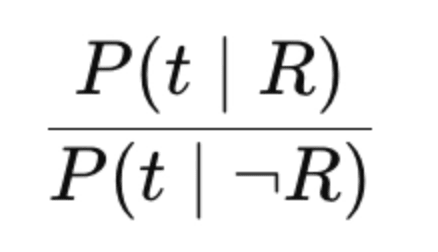
- t - a query term match occurs
- R - the doc is relevant
Queries of course contain multiple terms. How do we combine those odds? The odds of BOTH terms being in a relevant doc, we’d need to multiply Odds(t1) * Odds(t2).
If we take the log of these multiplied odds, we can take advantage of a property of logarithms: log(Odds(t1) * Odds(t2)) = log(Odds(t1)) + log(Odds(t2)). Or taken together across each term:
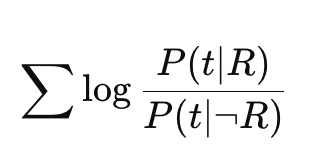
BM25 tries to model this!
How?
We can imagine cases where a term match would occur in a relevant doc (the numerator). Why might a term match occur an in an irrelevant doc?
- The term’s ambiguous, not specific to the user’s intent.
luke skywalker- luke occurs all over the place. It’s common. The rare termskywalkeroccurs only in only Star Wars → thats how we get Inverse Document Frequency. - The document is not ABOUT that term - A term occurring spuriously (low term frequency) would not mean the document is relevant. Or a term not being a large enough proportion of the text: Skywalker being mentioned a few times in a book length tome may just happen accidentally.
Through trial, error, and experimentation with open datasets we arrived at the exact BM25 formula.
That’s how we get a BM25 that’s probabilistic, but not a probability
My AI Powered Search training with Trey Grainger starts THURSDAY - signup here
-Doug
This is part of Doug’s Daily Search tips - subscribe here
Starting in November: AI-Powered Search — Modern Retrieval for Humans & Agents

Learn the latest AI search skills with the authors of AI-Powered Search. Join Doug Turnbull and Trey Grainger to explore modern retrieval for humans and agents. Explore the course on Maven.

Doug Turnbull
More from DougTwitter | LinkedIn | Newsletter | Bsky